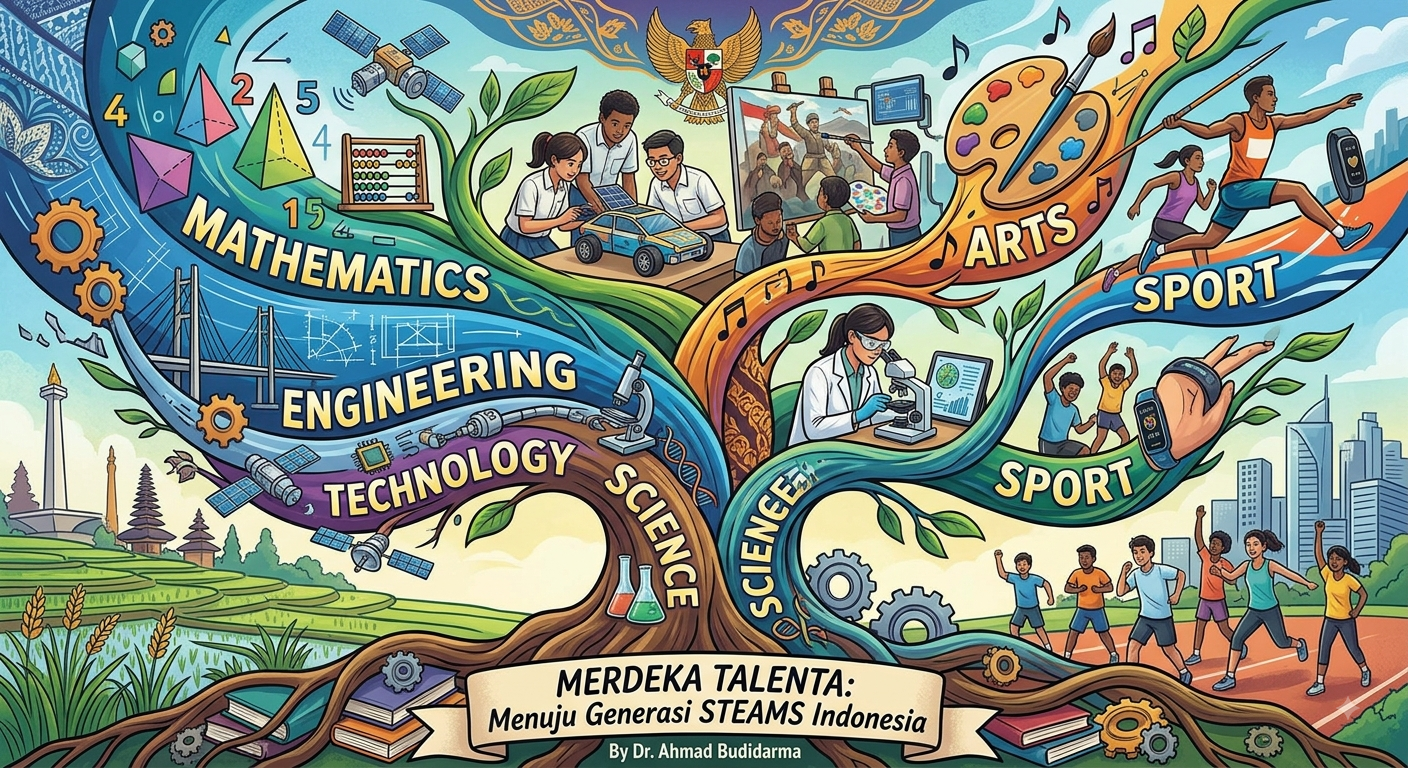
Talent Freedom: Time to Expand the STEM Educational Approach into STEAMS
By: Dr. Ahmad Budidarma
Lecturer at STIT Az Zahra Tasikmalaya – Educational Practitioner
Education must never stop at what has already succeeded. As the world changes, the way we prepare future generations must evolve alongside it. Therefore, the strengthening of STEM (Science, Technology, Engineering, and Mathematics) in Indonesian education deserves appreciation. However, amid the increasingly diverse needs of talent development, it is time for us to open a wider space: moving from STEM to STEAMS.
In this idea, STEAMS represents an expansion of STEM by adding two crucial dimensions: Arts and Sport. Thus, STEAMS encompasses Science, Technology, Engineering, Arts, Mathematics, and Sport.
This idea does not diminish the importance of science, technology, engineering, and mathematics. On the contrary, STEAMS seeks to emphasize that Indonesian children possess talents that are far more diverse than mere academic and technological capabilities.
Ever-Evolving STEM
STEM has developed into one of the vital approaches in global education. This is not only because the demand for a workforce in science and technology is continuously increasing, but also because STEM’s integrative approach encourages learners to solve real-world problems through inquiry, design, technological application, and mathematical reasoning.
However, recent literature indicates that STEM itself still faces challenges regarding how to integrate these disciplines meaningfully. A systematic literature review published in 2024 shows that research on integrated STEM education continues to grow, yet there remains a diversity of understanding regarding the principles, theoretical foundations, and characteristics of integrated STEM learning.
This means that future educational challenges are not merely about proliferating programs labeled as STEM, but about ensuring that STEM truly generates interdisciplinary learning experiences relevant to real-life issues.
Why Does STEM Need to Be Expanded?
In its development, the STEAM approach (Science, Technology, Engineering, Arts, and Mathematics) emerged, adding elements of art and creativity.
The addition of Arts is not merely about beautifying STEM. A number of studies show that integrating the arts can open space for creativity, alternative ways of thinking, design, communication, and problem-solving. A systematic study on STEAM in primary schools, for instance, found that the arts can provide new ways of thinking and knowing while simultaneously strengthening 21st-century skills such as creativity. However, the study also indicated that STEAM practices and assessment systems still require further development.
Another study published in 2024 specifically examined the integration of visual arts in STEAM. The results demonstrated the potential of this approach in enhancing learners' creativity, critical thinking, and problem-solving abilities.
Thus, the presence of Arts in STEAM has an increasingly strong literature foundation.
Where Does Sport Fit In?
This is where the idea of STEAMS becomes compelling.
If Arts expands STEM into the realm of human creativity and expression, then Sport expands it into the realm of the body, health, fitness, discipline, performance, and kinesthetic intelligence.
Sports are not merely physical activities. Modern sports, in fact, rely increasingly on science, technology, engineering, and mathematics.
Athletic performance is analyzed using data. Body movements are studied through biomechanics. Sports equipment is developed using engineering principles. Athlete nutrition utilizes biological and chemical sciences. Speed, distance, time, angles, and probabilities are employed in performance analysis. Sensor technology and artificial intelligence are increasingly used to read training patterns and athletic performance.
In other words, sports are truly a living laboratory for STEM.
However, when sports are placed as an explicit component within the STEAMS framework, the perspective becomes broader: sports do not only serve as an object of STEM application, but also as a dedicated space for developing student talents.
STEAMS Is Not Merely a Term
The concept of STEAMS is not without precedent in the literature. Research by Katsuro Kitamura published in the Japanese Journal of Physical Education and Sport for Higher Education in 2024 explicitly used the term STEAMS (Science, Technology, Engineering, Arts, Mathematics, and Sports) and examined how bodily learning in physical education can contribute to the development of STEAMS human resources.
Even more interestingly, a 2026 study titled Integrating STEAM Education with Sports for Interdisciplinary Learning developed and tested a curriculum connecting Science, Technology, Engineering, Arts, and Mathematics with sports-based learning. This study indicates that the relationship between STEAM and sports is beginning to become a more serious domain of interdisciplinary educational inquiry.
Of course, this literature is not yet sufficient to claim that STEAMS has become a globally established educational paradigm. Precisely for this reason, this idea needs to be positioned as a policy development and research agenda, rather than a claim that STEAMS is already a standard nomenclature in national or international education.
Talent Does Not Reside Only in the Classroom
Until now, discussions surrounding student talent have often been tightly bound to academic achievement. Children who excel in mathematics, science, technology, or programming are considered to have strong future prospects.
That view is correct, but incomplete.
There are children who possess extraordinary abilities in music, dance, visual arts, design, or theater. There are also children who possess remarkable physical abilities, body coordination, endurance, discipline, and kinesthetic intelligence.
They may not always be the top performers in mathematics exams, but they can become artists, creators, national athletes, or even world-class athletes.
The question is: Has our educational system provided an equal space for all these types of talents?
This is where STEAMS becomes relevant.
Schools as Talent Ecosystems
Expanding STEM to STEAMS also brings consequences for how we view educational institutions.
It is not enough for schools to function merely as places to deliver instructional material. Schools need to evolve into ecosystems for identifying, developing, and nurturing talent.
A student with potential to become a programmer needs space to learn coding, artificial intelligence, and digital technology. A student with artistic talent needs space to create and competent mentors. Meanwhile, a student with athletic potential requires coaches, facilities, training programs, and sports science support.
Schools do not have to do everything on their own.
Schools can build partnerships with universities, art communities, professional organizations, business and industrial sectors, sports governing bodies, sports clubs, and practitioners.
In the context of sports, for example, a school can bring in a coach from a specific sport as a guest teacher or instructor to reinforce skills among students. Regular teachers maintain their educational and instructional functions, while coaches provide specific expertise aligned with their competencies. Such a collaborative model makes the educational ecosystem more open and rich in experience.
From Competition to Sustainable Nurturing
STEAMS also needs to be positioned within a framework of sustainable talent development.
Attention to talent often spikes only after a child wins a competition. Yet, achievement is the result of a long process: identification, development, nurturing, mentoring, competition opportunities, evaluation, and ongoing support.
Therefore, the benchmark for the success of a talent policy should not merely be how many medals are won, but how many children successfully discover their areas of excellence and receive opportunities to thrive.
Within this framework, schools hold a strategic position as the primary place to recognize student potential. Teachers play a critical role in observing children’s interests and abilities. However, teachers do not have to be the sole source of expertise. A talent ecosystem requires collaboration with various parties who possess specific competencies.
The Challenge: Prevent STEAMS from Becoming Just an Acronym
There is one thing to watch out for. Changing terminology does not automatically generate educational transformation.
STEAM literature actually demonstrates that cross-disciplinary integration carries its own challenges, including teachers' limited cross-disciplinary competencies, still-fragmented school structures, and difficulties in assessing multidisciplinary learning outcomes.
Therefore, if Indonesia wishes to develop the STEAMS approach, what is needed is not simply replacing the term STEM with STEAMS.
What is required is policy design, curriculum, teacher capacity building, partnerships, facilities, talent identification systems, as well as assessment and nurturing mechanisms that support all six dimensions.
Time to Broaden the Definition of Talent
Indonesia needs a generation capable of mastering technology while also possessing creativity. We need scientists and engineers, but also artists and athletes. We need children who are academically strong, but also physically healthy, emotionally mature, capable of collaboration, and possessing strong character.
Therefore, STEAMS can serve as a more comprehensive perspective for viewing the diversity of student talents.
If STEM helps us prepare a generation capable of understanding and creating technology, STEAMS expands that perspective by ensuring that creativity and sports potential are also given adequate space.
In the end, education should not merely ask:
“In which academic subject does this child excel?”
Education also needs to ask:
“In which area does this child possess extraordinary potential, and how does the state help that potential flourish?”
It is time for us to expand that space.
From STEM to STEAMS: Not replacing priorities, but expanding opportunities so that more of Indonesia's young talents can be discovered, developed, and achieve greatness.
News
Talent Freedom: Time to Expand the STEM Educational Approach into STEAMS
Published on 12 August 2026