The Spirit of Independence as a Momentum to Strengthen Teachers’ Psychological Well-Being
Jakarta, August 12, 2026 — Resilient teachers are not teachers who are expected to keep enduring pressure without limits. Teacher resilience must be built alongside psychological well-being, a supportive work environment, protection, and opportunities for continuous growth.
This message was conveyed in a speech by the Director of Secondary and Special Education Teachers, Arif Jamali, S.Pd., M.Pd., represented by the Head of the Subdirectorate for Capacity Building, Protection, and Control at the Directorate of Secondary and Special Education Teachers, Eneng Siti Sa’adah, S.Si., M.B.A., at the opening of the webinar *“Rising Together with Resilient Teachers: Building Psychological Well-Being and the Spirit of Indonesian Independence,”* on Wednesday (August 12, 2026).
The speech emphasized that teachers hold a strategic position in developing the quality of human resources and preparing the nation’s future generations. Therefore, teachers need more than pedagogical and professional competencies; they also need resilience, adaptability, and adequate psychological well-being.
Changes in education, technological developments, student dynamics, and increasing work demands require teachers to manage themselves effectively, maintain motivation, build healthy relationships, and continue to find meaning in their profession.
For this reason, psychological well-being needs to become an integral part of strengthening teacher resilience and sustaining their dedication.
Joined by Teachers from Across Indonesia
Dr. Ahmad Budidarma, S.Kom., M.M., Head of the Learning, Well-Being, and Recognition Working Team, stated in his report on the event that the webinar was part of the Directorate of Secondary and Special Education Teachers’ efforts to provide a space for strengthening psychological well-being while fostering teachers’ spirit and resilience in carrying out their professional responsibilities.
“This activity was attended by teachers from across Indonesia. We also invited heads of provincial education offices, heads of district/city education offices, as well as Technical Implementation Units (UPTs) within the Directorate General of Teachers and Education Personnel,” said Ahmad Budidarma.
According to him, involving various education stakeholders is important because teachers’ psychological well-being cannot be built by teachers individually. It requires support from an education ecosystem involving schools, local governments, UPTs, and other stakeholders.
“We hope that the messages and experiences gained through this webinar will not stop with the participants, but can be passed on and become part of a collective effort to build an educational environment that is healthy, supportive, and capable of caring for teachers,” he added.
Resilience Is Not About Enduring Without Limits
The speech emphasized that resilience should not be interpreted as a demand for teachers to always be strong and face every pressure on their own.
“Healthy resilience means being able to recognize pressure, manage one’s response, seek support when needed, learn from experience, and return to one’s role with the awareness that the work being carried out has meaning.”
This perspective recognizes teachers as human beings who also need support, rest, recovery, and opportunities to grow.
Teachers’ psychological well-being therefore cannot be placed entirely on the individual. School principals, supervisors, local governments, education communities, and the broader work environment all have a role in creating spaces that allow teachers to work in a healthy, safe, developmental, and meaningful manner.
Learning from General Soedirman
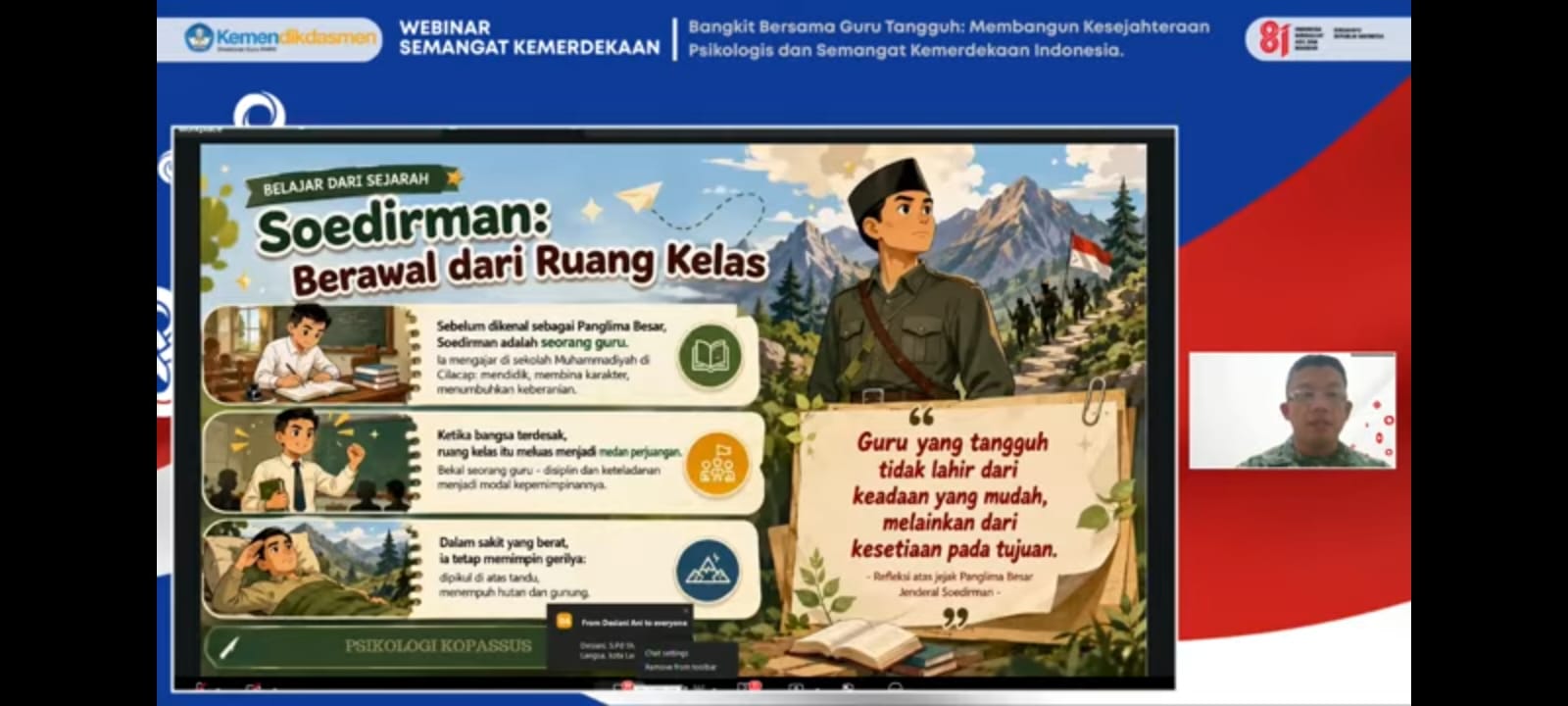
The Independence Day momentum was also used during the event to reflect on resilience through the figure of General Soedirman.
Before becoming known as the Commander-in-Chief of the Indonesian Armed Forces, Soedirman was a teacher at HIS Muhammadiyah Cilacap. His experience as an educator became part of the journey that shaped his character, discipline, leadership, social concern, and love for his country.
Soedirman’s example demonstrates that values cultivated through education can have an influence far beyond the classroom.
Perseverance, discipline, courage, simplicity, leadership, patriotism, and dedication remain relevant values for Indonesian teachers as they navigate the changing times.
Soedirman’s journey also conveys the message that great change can begin with sincere dedication carried out within the educational space.
Fulfilling Independence through Education
The speech also emphasized that the spirit of independence needs to be understood in the context of teachers’ dedication.
If the predecessors of the nation fought to achieve and defend independence, the task of the current generation is to fulfill that independence by ensuring the emergence of Indonesians who are capable of critical thinking, have strong character, live together with dignity, and continue learning throughout their lives.
Fulfilling independence through education is not merely about completing the curriculum. Education must provide every child with the space to feel valued, grow, dare to dream, and have hope for their future.
Therefore, teachers are not merely educators, but also character builders and providers of hope for future generations.
Building an Ecosystem That Cares for Teachers
The webinar emphasized the importance of building an education ecosystem that not only expects teachers to perform at a high level, but also provides the support they need to work in a healthy and sustainable manner.
Strengthening psychological well-being needs to go hand in hand with strengthening professional competencies. Teachers need opportunities to learn, collaborate, receive support when facing difficulties, and rebuild their confidence and pride in their profession.
The webinar featured Lt. Col. Inf. Freddy A. R. Simanjuntak, S.Psi., M.Psi., M.Han., Psychologist and Head of the Kopassus Psychology Unit, as a speaker. The event was also attended by officials from the Directorate General of Teachers and Education Personnel, local governments, UPTs, and teachers from various regions across Indonesia.
Through the momentum of independence, the event conveyed the message that caring for teachers as human beings is part of caring for the future of Indonesian education.
Teachers may feel tired. Teachers may need support. Teachers need space to recover. However, with a healthy ecosystem, teachers can rise again, continue learning, and give their best to their students.
**Ultimately, a resilient teacher is not a teacher who never gets tired, but one who is able to rise again, strengthen others, and continue to bring hope to the children of Indonesia.**
Watch the full video at the following link: https://www.youtube.com/live/UGdL-zlDlcg?si=DMdLnxm4EI93_sPI
News
The Spirit of Independence as a Momentum to Strengthen Teachers’ Psychological Well-Being
Published on 13 August 2026