"A healthy democracy grows when citizens have space to shape how collective life is governed, including how their living environment is cared for. In this context, exercising the right to a healthy environment forms part of a democratic practice that makes room for citizens’ knowledge and care in governance decisions."
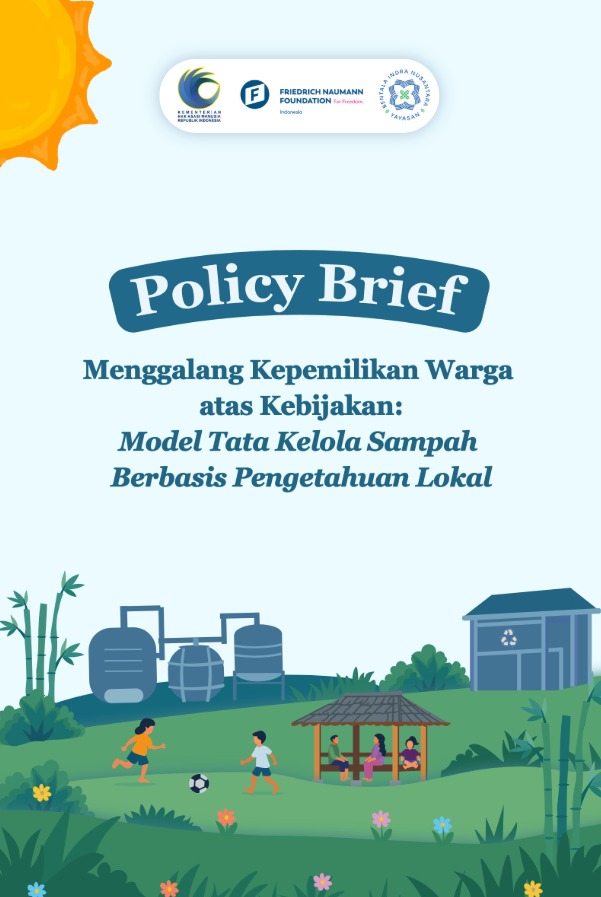
The connection between decision-making and the right to a healthy environment underpins the policy brief Policy Brief on Fostering Citizens’ Ownership of Policy: A Community Waste Governance Model Grounded in Local Knowledge. Published through a collaboration between the Ministry of Human Rights of the Republic of Indonesia, Friedrich Naumann Foundation (FNF) Indonesia, and Yayasan Bentala Indra Nusantara, the publication proposes a model that brings together physical waste management infrastructure, community capabilities, and social bonds to support sustainable waste management.
The publication places citizens’ initiatives to care for their environment at the heart of sustaining waste reduction and management policies at the local level. This emphasis draws on experiences in places where physical infrastructure and government interventions have yet to connect fully with local values and the bonds of care among residents. This gap also concerns how responsibilities and risks arising from everyday waste management are shared.
To examine these questions at the micro level, the policy brief combines an affective lens with risk analysis. The affective lens considers the care and social bonds that motivate citizens to look after their environment, while risk analysis examines challenges that may affect the continuity of waste management. Together, these perspectives help identify the support that different stakeholders can provide, according to their respective roles, in reducing and managing waste collectively.
Through this sharing of roles, stakeholders help shape decisions that influence everyday waste governance. Fair and equitable involvement can nurture ownership of policy, strengthening shared responsibility for creating a healthy environment. The proposed model thus seeks to support national targets while fostering meaningful participation among those involved.
The policy brief is intended as a source of inspiration and reflection for government officials, businesses, NGOs, philanthropic organizations, residents, communities, academics, and others working to develop and evaluate environmental governance initiatives. We hope its ideas will also inform policy practices that foster citizens’ ownership through participation in decision-making, enabling a healthy environment to be pursued collectively, equitably, and sustainably.
Download the full policy brief in Indonesian here (PDF)
Publication Credits
Authors: Muhammad Gufron Rum, S.I.P., M.A.; Faustina Rosalia, S.I.Kom., M.A.; Arrida Hamzah, S.I.P.
Editor: Salomo Zakharia Tungga, S.I.P., M.A.
Layout and design: Nurul Rahayu, S.I.P.
Published: October 2026.
Length: 35 pages, including the cover.
Dimensions: 15.5 × 23 cm.
Copyright: © 2026 Yayasan Bentala Indra Nusantara.