Have you encountered a programme that appears to have been carefully designed yet faces considerable challenges during implementation? In such circumstances, these difficulties are often attributed to the complexity of conditions on the ground, which the programme is considered insufficiently equipped to address. Although this explanation is plausible, it warrants further consideration: do these difficulties arise solely from the complexity of actual conditions, or might alternative explanations emerge from a reassessment of how the problem has been understood and formulated?
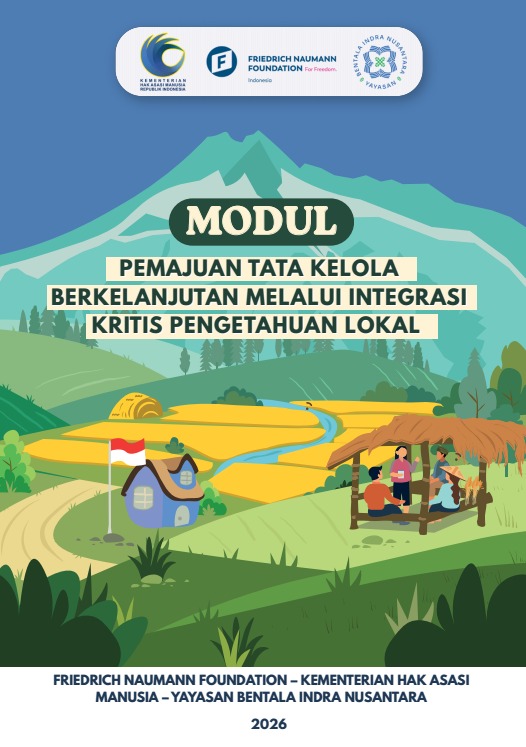
The Module on Advancing Sustainable Governance through the Critical Integration of Local Knowledge was developed to assist readers in examining this question. Drawing on agricultural experiences in the Special Region of Yogyakarta, the module explores how knowledge derived from everyday practices can enrich the understanding of problems addressed by policies and programmes at the local level. Readers are encouraged to examine how communities understand their circumstances and how this knowledge can inform problem formulation and the identification of appropriate courses of action.
Published through a collaboration between the Friedrich Naumann Foundation, the Ministry of Human Rights of the Republic of Indonesia, and Yayasan Bentala Indra Nusantara, the module comprises two parts. The first explains local knowledge and its role in public policy. It examines the relationship between community experiences, research findings, and applicable regulations in identifying problems and determining appropriate responses. The second provides practical guidance for undertaking this process. It guides readers through the selection of topics in collaboration with communities, the identification of informants, the conduct of interviews and observations, and the preparation and review of field notes. The resulting findings inform the design of activities, adjustments during implementation, and the evaluation of ongoing programmes.
Presented in accessible language, the module is intended for government officials, community facilitators, civil society organisations, students, and programme implementers. For general readers, it offers an alternative perspective on issues encountered in everyday life. It demonstrates how experiences commonly regarded as ordinary can constitute valuable knowledge for understanding problems and formulating well-considered solutions.
Download the complete digital edition here (PDF).
Publication Credits
Authors: Muhammad Gufron Rum, S.I.P., M.A.; Faustina Rosalia, S.I.Kom., M.A.; Arrida Hamzah, S.I.P.
Editor: Salomo Zakharia Tungga, S.I.P., M.A.
Layout and Design: Nurul Rahayu, S.I.P.
Edition: First edition, September 2026.
Extent: 84 pages, including the cover.
Dimensions: A4, 21 × 29.7 cm.
Copyright: © 2026 Yayasan Bentala Indra Nusantara.